This movement is an initiative of the political party Por un Mundo más Justo, with the intention that it may eventually become a broader citizens’ movement.
Why was “Weaving Peace” created?
Because we live in times marked by violence, polarization, and fear; yet most people want to live together peacefully, understand one another, and coexist in harmony.
“Weaving Peace” was born to promote a culture of peace, to show that the desire to live in peace is part of who we are and a shared priority within society.
Peace is built in everyday life: in the way we speak, debate, resolve conflicts, and participate in public life.
Peace is not waited for — peace is woven
That is our motto. We believe peace is not a passive expectation, but a collective decision that involves a way of living and relating to one another.
Peace is practiced, shared, and spread.
A symbolic gesture: weaving together
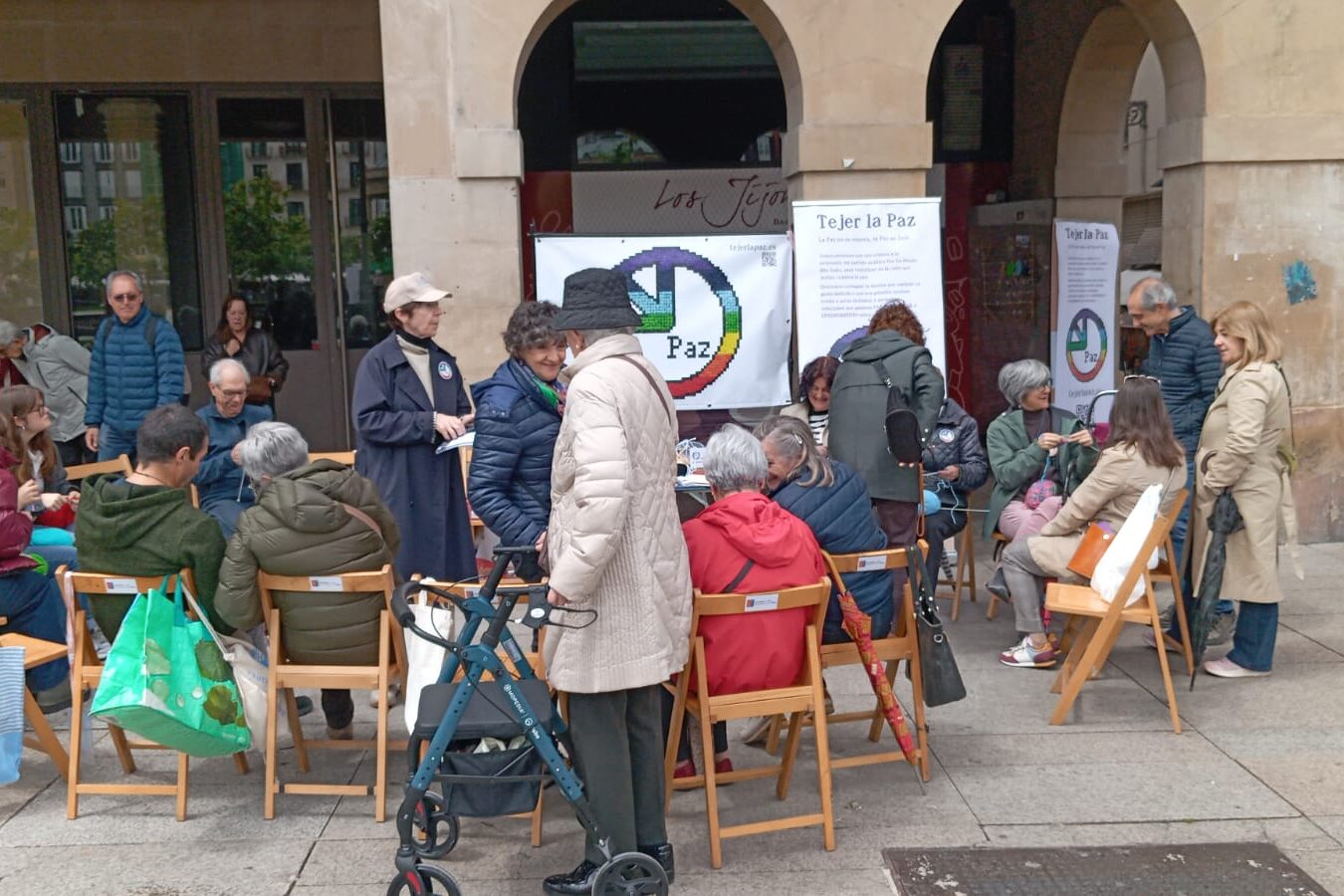
We have chosen the symbolic act of sitting together to knit with needles and colorful yarns, because knitting means joining different threads without breaking them. Through this gesture we express:
That we understand diversity as a source of richness
That we choose dialogue and diplomacy over war or the law of the strongest
That we choose to defend the life and dignity of every person
That we choose to build coexistence here and cooperation beyond our borders
Objectives
- To bring together more and more people who want to build community
- To fill the streets with symbols that unite rather than divide
- To spread a culture of peace through social media
- To multiply visible gestures of peace En Barcelona, Valencia y alguna ciudad de Andalucía lo harán un poco más adelante.
To this end, on Saturday, May 16, we gathered in Pamplona, Bilbao, Oviedo, and Madrid to introduce ourselves and make the movement known. In central areas of each city, we formed circles of people knitting with needles and yarn, talking calmly and teaching those who did not know how to knit.
We also took the opportunity to explain our gesture and purpose to passersby, distributing leaflets and the “Weaving Peace” logo.
In Barcelona, Valencia, and some cities in Andalusia, similar events will take place a little later.
Our intention is to repeat these gatherings regularly.
A gesture — and something more
As a political party, we are reflecting from the conviction that lasting peace requires fairer societies, a critical and supportive citizenry, and institutions that place people at the center of politics.
From this conviction arise a series of proposals, ranging from the global to the local level, which we are committed to advancing. For example:
“Security means investing in life, not in weapons”: We choose the defense of life and comprehensive human security over the arms business and the horror of destruction. History shows us that violence breeds violence, and weapons do not solve problems in the long term.
Therefore, we propose:
1. Ensuring transparency and accountability in defense budgets through:
a) Conducting an annual independent, transparent, and public audit to inform citizens about the management of public spending
b) Avoiding the use of budgetary engineering that disguises military spending within the budgets of other ministries
c) Requiring public online consultations before increasing approved defense or security budget allocations
2.- We must not fuel the arms race by increasing state and European military spending. We propose reallocating these funds to meet the basic needs of the public.
3. Rejecting further militarization and arms escalation. We oppose increasing military spending at both the national and European levels. Instead, we propose redirecting those funds to meet citizens’ basic needs.
These and other proposals are currently being developed by a working group and will later be shared with party members.
A “School of Weaving Peace” has also been created as a space for reflection and education for members. So far, we have held an online talk followed by questions and discussion. The speaker emphasized that peace is absent from both political agendas and the media; at this moment there are 40 ongoing peace processes around the world that nobody talks about.
She encouraged us to continue our work humbly, without allowing ourselves to be paralyzed by the context of barbarism in which we are immersed. We must remain convinced that peace is possible
The initiative almost failed because of the confrontation between PSOE and PP, but it was ultimately approved by Congress with the support of all parties except Vox.
Popular Legislative Initiative for the Regularization of Migrants
The Popular Legislative Initiative (ILP) for the extraordinary regularization of migrants was launched at the end of 2020, and more than 700,000 signatures were collected throughout 2021. A total of 14,000 people participated in gathering signatures, and more than 900 very diverse organizations united around the cause. This helped the proposal to be perceived as a broad, cross-cutting citizens’ movement. The number of signatures required for an ILP is 500,000.
Migrants such as Lamine Sarr and the spokespersons of Regularización Ya became the visible faces of the campaign, since they were the direct protagonists of the proposed law.
The party Por un Mundo más Justo provided the organizational structure — people, digital tools, and logistical support — that enabled the signature campaign to succeed. This was followed by tireless work to convince political parties to allow the proposal to proceed through parliament.
The initiative almost failed because of the confrontation between PSOE and PP, but it was ultimately approved by Congress with the support of all parties except Vox.
Unfortunately, after parliamentary debate and the presentation of amendments in committee, the ILP stalled due to a lack of political will. Eventually, the government, through an agreement with Podemos, approved the extraordinary regularization by decree.
Ideally, this measure would have become a law supported by a majority of Congress, but given the current climate of polarization and political division — compounded by the xenophobic discourse of some politicians — this was not possible.
At present, and until the end of June (likely with an extension), more than 500,000 people are attempting to obtain legal status; in other words, the possibility of living with a minimum of dignity.