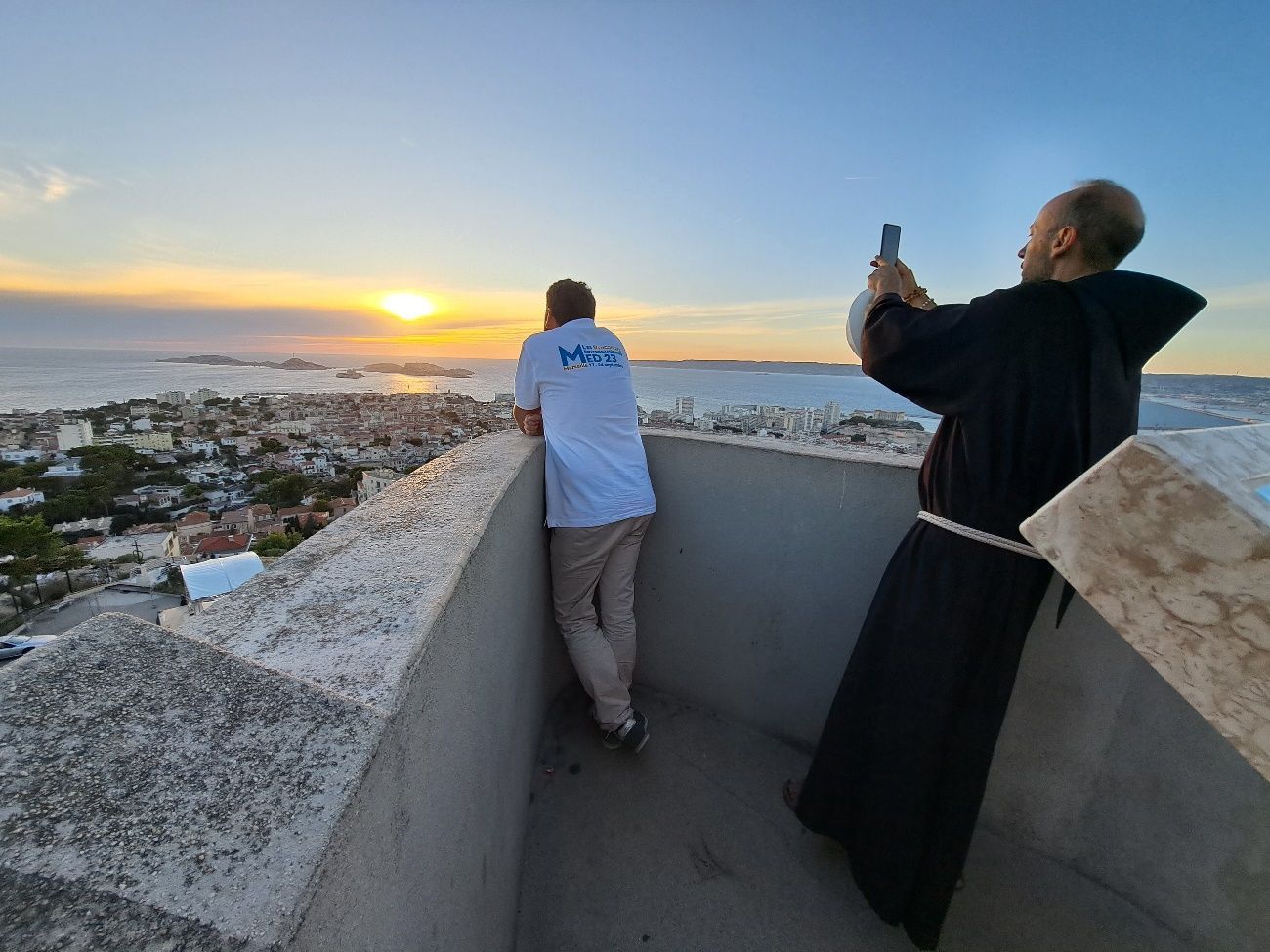
As members of the Committee of the Franciscan Network of the Mediterranean, we were invited to participate from September 17th to 24th, 2023, in the III Encounter of the Churches of the Mediterranean in Marseille. It is worth noting that the first was in Bari and the second in Florence, only for the bishops; the novelty in this third encounter was that young people from different backgrounds and religions participated on an equal footing.
The program was extensive and intense. We began with the first presentation in the ‘Regional Parliament,’ which was led by Bishop Nicholas Lhernoud of Constantinople and Hippo. There were 70 young people from all confessions and religions invited to participate in the week-long meeting. The youth started on Monday, and the bishops from 25 countries joined on Wednesday, also having their own meetings. From Friday onward, there were joint sessions between the youth and bishops. The event concluded on Saturday with an Assembly of young people and bishops alongside Pope Francis at the Lighthouse Auditorium, followed by Mass at the Orange Stadium in Marseille, attended by a full capacity crowd of 60,000 people.
This third Mediterranean encounter bore the theme: “Mediterranean: Mosaic of Hope,” with the shared goal of having this mosaic of peoples, cultures, and religions that make up the Mediterranean build and share a common hope.
We are very aware that the Mediterranean reality is a common yet fragmented space, a theater of conflicts, a gift of creation, cradle of faith, frontier of peace, tragic abyss, space of exchange, unity, and threatened fragility, a treasure of spirituality and history, a space of blissful coexistence, and a polyvalent history with many wounds as well.
The initial theme proposed to us was “Choosing Life”… from the longing that we experience in this era, recognizing the dignity of every human person, in order to revive among all a global desire for brotherhood. Among all: “as a beautiful secret to dream and make our lives a beautiful adventure; since no one can fight life alone”.
Aware that we need a community to support and assist us, where we lean on each other to look forward. Because dreaming together is important! For when alone, we risk seeing mirages, where there is nothing; and knowing that dreams are built together.
“Let us dream as one humanity, as travelers of the same human flesh, as children of this same earth that shelters us all, each with the richness of their faith or convictions, each with their own voice, all brothers” (Fratelli Tutti n.8 – 2020).
The objectives of the encounter were: To achieve concrete actions of reconciliation and solidarity among peoples, starting from the most vulnerable individuals, addressing ecology, freedom of conscience, peace and conflicts, education, and more.
Knowing that, as human beings, we are made in such a way that we cannot fulfill ourselves, develop, or find fulfillment “except in the sincere giving of oneself to others.” For we are not capable of fully recognizing our own truth if it is not in encountering others: “I truly communicate with myself only to the extent that I communicate with the other.” This explains why no one can experience the value of living without concrete faces to love. Herein lies the secret of true human existence because “life subsists where there is bond, communion, and fraternity; and it is a life stronger than death when built on true relationships and bonds of fidelity. Conversely, there is no life when we pretend to belong only to ourselves and live as islands: in these attitudes, death prevails” (Fratelli tutti n.87 – 2020).
That’s right, it is necessary to help recognize that the only possible path consists of learning to “encounter the other” in a fair manner, appreciating and accepting them as fellow travelers, without inner resistance. Moreover, it is about learning to discover Jesus in the faces of others, in their voices, in their demands… (The Joy of the Gospel n.91 – 2013).
“Solidarity, understood in its deepest sense and as a challenge, is a way of making history, where tensions and oppositions can achieve a multifaceted unity, a unity that generates new life” (The Joy of the Gospel n.228 – 2013).
“These are bad times, difficult, we repeat everywhere. Let us live well and the times will be good. It is we who make the times good or bad; time is what we make of it” (St. Augustine. Sermon 80,8).
In summary, it is possible to live life not as an expression of an idea but as the unfolding of freedom and a call to communion.
Understanding that each personal and collective story is a message that unfolds and develops step by step, where we must learn to listen and share.
Recognizing that this unveiling constitutes the dynamics of history; by consenting to it and embarking on this journey of listening and sharing, we contribute to the development and construction of a Mediterranean as a “mosaic of hope”.